

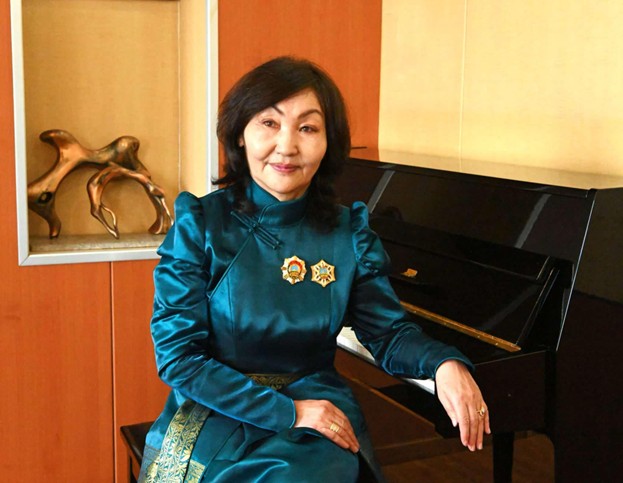
An interview with Professor J. Dolgorsuren, PhD, Director of CITI University’s Institute of International Cultural Studies.
— Following the Lunar New Year celebrations, could we begin with the culture and customs of Tsagaan Sar?
— Mongolian national culture draws on the traditions of many ethnic groups, including Zakhchin, Uriankhai, Khotgoid, Khalkha, Dariganga, Bayad, Durvud, Uzemchin and Buryat. Tsagaan Sar brings together the Mongolian language, traditional knowledge, the ger, food, clothing and folk arts. It is a complex cultural tradition expressing distinctive Mongolian intellectual and spiritual values. Its complexity reflects Mongolia’s climate and geography; the pastoral nomadic way of life; and related understandings of living nature, aesthetics, customary practices, rituals, beliefs and ecological knowledge. Tsagaan Sar and Naadam express nomadic culture, shared ideas and social cohesion. Naadam’s inscription on UNESCO’s Intangible Cultural Heritage list in 2010 recognises its cultural value. Tsagaan Sar likewise has profound symbolic meaning. It marks the transition from the old year to the new in the Asian calendar, but differs from other Asian spring festivals in timing and practices. It expresses Mongolian relationships among people, nature and society through beliefs, affection and respect. Its central symbolism concerns herders and livestock passing safely through winter and entering spring. Because Mongolians share pastoral roots and benefit from livestock, the festival also supports national unity and social continuity. In this sense, national independence is closely connected with Tsagaan Sar and Naadam, and these traditions deserve respect. Celebrating according to inherited customs and greeting relatives strengthens family, social and national ties. This explains public policy support and the preparations made well in advance. People appeared pleased with the extensive celebrations this year. Modern technology and the cultural exchanges it enables also create challenges. There are concerns that the Mongolian language and ethnic cultures may lose their distinctive foundations. In The Decline of the West, Oswald Spengler described cultures as organic entities that pass through stages of birth, growth, ageing and decline. From this perspective, traditions such as Tsagaan Sar also change over time and across places. Changes in outward forms are less concerning than changes in their internal symbolic meaning, which I regard as essential to national continuity. Traditional culture supports care for nature, respect for elders, goodwill and social harmony. We therefore have a responsibility to explain and transmit Tsagaan Sar’s meaning to younger generations as part of safeguarding cultural continuity.
— How do you view the development of cultural and creative industries?
— V. I. Lenin advanced the idea that culture developed without policy can leave a desert behind it. In other words, a lack of public cultural policy can harm a nation. Particularly in a market society, cultural values may be lost without thoughtful regulation. This was one reason Mongolia adopted a cultural policy document and the Law on Culture in 1996. Cultural policy has since been amended 12 times. Rapid social change requires continuing revision of policy and the legal framework. Bringing culture into economic activity and developing a knowledge economy is one response, requiring cultural and creative industries. We must distinguish which aspects of national culture can develop through market mechanisms and which require protective state policy. The Law on Supporting Cultural and Creative Industries was adopted in 2024 and is being implemented. It has two objectives: protecting cultural heritage and producing cultural goods for the market to develop a knowledge economy. These objectives can be in tension, but both serve social needs. The Ministry of Culture’s policy covers 12 sectors and 93 areas of cultural and artistic goods and services for domestic and international markets. Film, music, fashion, design, publishing and digital content are prominent. Cultural tourism is another area. Mongolia has substantial cultural heritage, but guides do not always have the knowledge to explain it adequately. Much work remains to develop the cultural economy and present cultural products effectively.
— Could you describe CITI University’s Institute of International Cultural Studies?
— Mongolia has three research institutes working in cultural and arts studies, including ours. The Arts Studies Section established at the Academy of Sciences’ Institute of Language and Literature in 1975 laid the foundation for the present Research Institute of Culture and Arts at the Mongolian National University of Arts and Culture. In 1998, the International Institute for the Study of Nomadic Civilizations under the auspices of UNESCO was established through an intergovernmental agreement involving Indonesia, Kazakhstan, Kyrgyzstan, Türkiye and Mongolia, following the initiative of UNESCO Director-General Federico Mayor. The third institute is CITI University’s Institute of International Cultural Studies, established in 2024. Cultural studies is developing as a relatively independent academic field in Mongolia, with bachelor’s, master’s and doctoral education. We aim to bring researchers together and develop research, present work on Mongolian nomadic culture internationally, and cooperate with Mongolian studies scholars abroad. Since establishment, the institute has signed a cooperation agreement with a Mongolian studies centre in Washington, United States, participated in its international conference and published a presentation. In August 2024, we also worked with Cambridge scholars to organise Cambridge Forum II in Ulaanbaatar. CITI University has undertaken a Ministry of Culture-commissioned project to develop short courses in cultural education for the public.
— Which master’s and doctoral programmes are available at the Graduate School?
— CITI University’s Graduate School was established in 2021. It offers doctoral programmes in Business Administration, Art Studies, Cultural Studies and Management, and master’s programmes in Business Administration, Tourism, Art Studies, Cultural Studies, Vocal Performance, Fashion Design, Education, Law, Journalism and Cosmetology Technology. This academic year, 411 postgraduate students are enrolled, including 75 doctoral candidates. In the past year, nine candidates earned PhDs in Art Studies in areas including design studies, vocal performance, instrumental performance, new media art and smart urban landscape design. Master’s students conduct research on issues in their professional fields, identify policy-level solutions and contribute to evidence-based professional development. They complete and defend research and development work or graduate through a professional examination.