

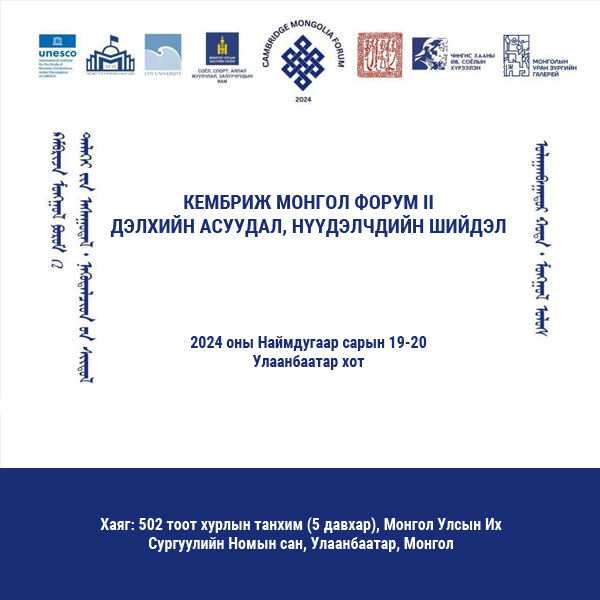
Mongolia has undergone substantial changes in national identity over the past century. Where nomadic life and the histories of feudalism and socialism once represented Mongolians as a backward nation, a national identity grounded in pride in the history and culture of Chinggis Khan and nomadic civilisation is now emerging. This change is particularly evident in two major initiatives launched after the COVID-19 pandemic. The first is the establishment of the Chinggis Khaan National Museum as a leading national cultural institution. The second is the launch of the Nomad World Cultural Festival, intended to present the Mongolian nation as a centre of the world’s nomadic peoples and civilisations.
Mongolia is not alone in emphasising nomadic life and cultural heritage. This raises the question of Mongolia’s position in relation to other countries and peoples that continue, to varying degrees, to preserve nomadic heritage, including China, Russia and the countries of Central Asia. The forum therefore considers the significance of Chinggis Khan and nomadic civilisation in finding responses to challenges facing both Mongolia and the wider world, including warfare and climate change. It will also provide a platform to discuss the foundations of a new vision for Mongolia.
Organisers:
Mongolia and Inner Asia Studies Unit (MIASU), University of Cambridge
Ministry of Culture, Sports, Tourism and Youth of Mongolia
International Institute for the Study of Nomadic Civilizations under the auspices of UNESCO
Institute for Chinggis Khaan Heritage and Culture
Institute for Mongolian Studies, National University of Mongolia
CITI University
Mongolian National Art Gallery
Organising Committee:
· Professor Uradyn E. Bulag, University of Cambridge
· Professor D. Bum-Ochir, Member of the State Great Khural of Mongolia
· I. Byambabaatar, PhD, Academic Secretary, Institute for Mongolian Studies, National University of Mongolia
· Ch. Munkhtuul, PhD, Director, International Institute for the Study of Nomadic Civilizations under the auspices of UNESCO
· N. Saruul, PhD, Director, Institute for Chinggis Khaan Heritage and Culture
Coordinator: International Institute for the Study of Nomadic Civilizations under the auspices of UNESCO (IISNC)
The forum will take place in person and online. For enquiries, contact secretariat@unesco-iisnc.com.
Registration for in-person attendance: https://docs.google.com/forms/d/e/1FAIpQLSeX65ozvslBoMSmaEdvqG2vXQH4Hi0QKjIheW4SkoOM4e7l6Q/viewform?usp=sf_link
Venue: Conference Room 502, fifth floor, Library of the National University of Mongolia, Ulaanbaatar, Mongolia
Registration for online attendance: https://us06web.zoom.us/j/83281847714?pwd=7HKhrMicqQtHY6YubDHBAeppxXIsym.1
Zoom meeting ID: 832 8184 7714
Passcode: 213021
Day One: 19 August—Monday
08:30 - 09:00: Registration
09:00–09:10: Opening of the forum — Mongolian long song and morin khuur performance
09:10–09:30: Uradyn E. Bulag (University of Cambridge): Introduction to the forum
09:30–09:45: Opening remarks
· Ch. Nomin, Minister of Culture, Sports, Tourism and Youth of Mongolia
· Fiona Blyth, Ambassador of the United Kingdom of Great Britain and Northern Ireland to Mongolia
· S. Bayar, former Prime Minister of Mongolia
Keynote Address
09:45–10:30: Timothy May (University of North Georgia)
Nomadic Civilisation and Military Innovation
For approximately two thousand years, from 500 BCE to 1500 CE, nomadic mounted archers were among history’s dominant warriors. In the modern period, however, the introduction and use of firearms gradually weakened the military superiority of the nomads of the Central Eurasian steppe, a process continuing into the late eighteenth century, as sedentary civilisations became dominant. Consequently, steppe warfare and its achievements over two millennia are often considered to have disappeared along with the large bodies of mounted archers, their movements and tactics such as the Parthian shot, feigned retreat and encirclement. Historical evidence may suggest that these methods of combat endured for centuries without substantial change. Yet contemporary historians and scholars often overlook or deny the significance of military achievements originating in nomadic societies. These achievements involved not only weapons and armour but also tactics, strategy, military composition and particular units of state organisation. Although mounted archers have little relevance on twenty-first-century battlefields, knowledge of steppe warfare should be considered in relation to the needs of modern armed forces.
10:30 - 10:45: Tea break
Panel 1: Traditions of Nomadic Statehood and Their Contemporary Relevance
Moderator: Uradyn E. Bulag
10:45–11:30: David Sneath (University of Cambridge):
Property Regimes of Ruling Elites in Pre- and Post-Socialist Mongolia: Comparing Aristocrats and Neoliberal Oligarchs
During the twentieth century, Mongolia experienced two periods of revolutionary transformation. First, the Buddhist aristocracy was overthrown and a Soviet-style modernist nation-state established. Subsequently, the socialist state collapsed and gave way to a neoliberal market economy and parliamentary government. This paper compares the ideological and material position of the ruling Borjigin elite in the pre-revolutionary period with Mongolia’s contemporary “oligarchic” political regime. It focuses in particular on property regimes in the pre- and post-socialist political economies, examining the nature of elite entitlements in relation to resources, activities and people.
11:30–12:15: L. Munkh-Erdene (National University of Mongolia)
The Nomadic Origins of the State: Extra-Human Transport and Military Organisation
This paper rejects the dominant theory of state origins as a myth and revives the conquest theory, refining it through the concept of extra-human transport to argue that nomads founded the state. It thus places nomadic organisation at the beginning of the state and civilisation, and the Eurasian steppe at the centre of human history.
12:15 - 13:30: Lunch
Panel 2: Who Is Afraid of Nomadic Civilisation?
Moderator: David Sneath
13:30–14:15: I. Byambabaatar and Ts. Turbat (National University of Mongolia)
UNESCO’s Approach to Supporting Nomadic Civilisation: Mongolian Perspectives
This paper discusses how Mongolia has successfully used UNESCO membership to protect and revive its traditional culture and heritage while negotiating established political debates and narratives. Mongolia joined UNESCO and its conventions to promote national culture, ease domestic political pressures and strengthen its international voice. After becoming a UNESCO member in 1964, Mongolia achieved universal adult literacy in 1968, actively contributed to the publication of the six-volume History of Civilizations of Central Asia from 1976 to 2010, and participated in UNESCO’s Silk Roads programme. Such active engagement also played an important role in establishing UNESCO representative offices and affiliated research institutes and centres in Mongolia and Central Asia in 1989 and 1998. In 2023, UNESCO adopted a resolution proposed by Mongolia to publish a six-volume UNESCO History of Nomadic Civilizations. These initiatives and projects, connected with changes in foreign and domestic policy, have substantially influenced Mongolian society, particularly scholars and politicians.
14:15–15:00: Thomas White (Imperial College London)
China’s Camel Country: Making Pastoralism into Cultural Heritage
Over the past decade or so, China has implemented policies to restore degraded grasslands. These have included attributing grassland degradation to ethnic minority herders, relocating them from pastoral areas and controlling or restricting livestock numbers. This paper explains how Mongols in Alashan, western Inner Mongolia, have resisted these policies and invoked the protection of local cultural heritage to defend camel husbandry. Consequently, alternatives were required to separating pastoralism from Mongolian ethnicity in accordance with China’s economic and nation-building priorities. The paper therefore argues that reimagining pastoralism as heritage depends on specific political circumstances.
15:00–15:45: Carole Ferret (French National Centre for Scientific Research)
Ambiguities of Kazakh Nomadic Culture and Heritage
Kazakhstan regained independence in 1991 and made nomadic heritage a foundation of national pride and distinctiveness. Nevertheless, negative stereotypes about nomads persist, and combining pastoralism with modernisation remains difficult. Russia and Kazakhstan held ambivalent positions on these issues during the nineteenth and twentieth centuries. In the 1930s, forced sedentarisation and collectivisation resulted in famine affecting one third of the Kazakh population. After independence, nomadic culture came to be emphasised through selected symbols such as the yurt and the horse. Kyrgyzstan and Kazakhstan, for example, compete to claim Central Asian mounted goat-carcass games, which are misleadingly described as “nomadic games”. Yet this emphasis on nomadic culture overlooks mobility, settlement and the actual practices of nomads—the central characteristics of nomadism—relegating nomadism to the historical past. Ethnographic fieldwork in southeastern Kazakhstan nevertheless indicates that nomadic pastoralism remains resilient today.
15:45–18:00: Speakers visit the Chinggis Khaan National Museum and view the exhibition Chinggis Khaan: How the Mongols Changed the World.
18:30–20:00: Reception, ground floor of the Novotel Hotel
Day Two: 20 August 2024-Tuesday
08:30 - 09:00: Tea break
Panel 3: Nomadic Games: Competition and Cooperation
Moderator: Timothy May
09:00–09:35: Tyntchtykbek Tchoroev (Kyrgyz National University)
Kyrgyzstan as a Centre of the Nomadic World: Tourism and the World Nomad Games
The Kyrgyz are among the peoples of Central and Inner Asia who have carried and preserved nomadic sports, games and traditions throughout history and into the present. Turkic runic inscriptions, Mahmud Kashgari Barskani’s “Diwanu Lugati t-Turk”and the Kyrgyz epic Manas provide extensive historical and ethnographic evidence about nomadic sports and games. The episode “Games in Memory of Khan Kokotoy” describes the Kyrgyz organising nomadic “Olympics”, inviting even their enemies from Central, Inner and East Asia. An intriguing historical account links disputes among participants at an Ordo competition in 1854 to the conflict between the Kyrgyz Bugu and Sarybagysh tribes in the 1850s. Nevertheless, nomadic games were also considered part of diplomatic efforts to strengthen peace between tribes and nations. They became an important element of great assemblies, feasts, celebrations and other social occasions.
The Kyrgyz maintained their national sports even under communist rule (1918–1991). National games formed part of the seasonal festivities of collective- and state-farm herders and other working people. In the second decade of the twenty-first century, the independent Kyrgyz Republic began pursuing a policy of holding the World Nomad Games as an Olympic-style sporting and ethnographic event. It hosted the Games three times, in 2014, 2016 and 2018, before they moved to Turkey (Iznik, 29 September–2 October 2022) and Kazakhstan (Astana, 8–14 September 2024). The Kyrgyz Republic hopes to host the sixth World Nomad Games. These sporting events have helped transform Kyrgyz tourism into a seasonal industry centred on nomadic themes. Modern yurt settlements with electricity and other amenities have been established in almost all of Kyrgyzstan’s high, alpine-style valleys, welcoming domestic and international visitors in summer. With a new winter tourism sector also drawing on origin myths associated with the Kyrgyz mountains, this Central Asian republic is developing into a contemporary tourism centre of the nomadic world.
09:35–10:10: Azamat Maksudunov (Kyrgyz-Turkish Manas University)
The World Nomad Games as a Mega-Event: Economic, Social and Cultural Dimensions
Mega-events such as the Olympic Games and world championships attract public attention and have international significance. They may have positive or negative economic, cultural and social effects on host regions. The World Nomad Games have likewise affected host countries in different ways. This presentation examines selected economic and sociocultural effects of holding the Games in Kyrgyzstan. It discusses in particular their role in promoting the country as a tourism destination and national brand, and in preserving and developing nomadic culture. Kyrgyzstan has hosted the event three times, beginning in 2014. As the country that initiated the Games, its experience merits attention. By bringing ethnic sports and traditional games to a new level, the event has positively affected Kyrgyzstan’s economy, society and culture. It has also contributed substantially to reviving the values of nomadic culture and promoting them internationally.
10:10–10:45: D. Bum--Ochir (Member of the State Great Khural of Mongolia), E. Munkh-Uchral (National University of Mongolia)
Nation Branding and the Historical Trajectory of Mongolian National Character
This paper examines issues surrounding the recent emergence of the concept of national values in Mongolia, focusing on efforts by the Mongolian National Branding Council to investigate the historical significance of Mongolian national and individual character. The first section briefly introduces the council, established under the then Prime Minister in 2017 and recently discontinued. The second explores the origins and development of the concepts of national values and shared national values. The third presents the principal findings of the council’s research project, A Study of the Sources of Mongolian Virtues and Morality, conducted by the authors. Finally, the paper considers how national character studies, which became prominent in American and Japanese anthropology and psychology in connection with warfare in the mid-twentieth century and during the Second World War, are developing in contemporary Mongolia within nation-branding policy.
10:45 - 11:00: Tea break
Panel 4: Nomadic Culture and Mongolia’s Development
Moderator: D. Bum-Ochir
11:00–11:40: J. Temuujin (CITI University), J. Dolgorsuren (CITI University),
E. Zoljargal (University of Cambridge)
How Clean Is the Steppe? From Traditional Culture to Contemporary Waste Practices and Technological Solutions
The need to survive through pastoral livestock husbandry across a vast territory with thin soils, four distinct seasons and an extreme climate has fostered and transmitted a society and culture that respect natural processes and sustain environmentally responsible ways of living, providing a foundation for development today. The domestication of the five principal livestock species, knowledge and protection of nature, beliefs, taboos and simple ways of life contributed to a clean and environmentally considerate civilisation. Urbanisation and industrialisation, however, have increased waste and created disposal sites. For example, 210,000 households in Ulaanbaatar’s ger districts use more than 800,000 tonnes of coal as fuel. The city’s power stations burn approximately five to six million tonnes of coal annually, producing some 500,000–600,000 tonnes or more of coal-combustion by-products. This joint presentation considers Mongolia’s waste sector and management from several perspectives. Topics include traditional knowledge that values environmentally responsible culture, current arrangements for centralised waste disposal and technological approaches to generating energy from waste ash. We first examine Mongolian cultural and historical practices of keeping the steppe and the home clean. The second section presents ethnographic observations from the Ulaanchuluut landfill, illustrating economic, environmental, human and social concerns. We also discuss the potential use of electrostatic precipitator fly ash and ash-pond residues in concrete, geopolymer and glass-ceramic production. Coal-fired thermal power stations generate large volumes of waste ash that pose risks to the environment and public health. Research into environmentally responsible processing of ash into value-added products is therefore necessary and consistent with national sustainable development policy.
11:40–12:20: Elizabeth Fox (University of Cambridge), S. Enkhbat (University of Cambridge)
Introducing a Mongolian Meat Standard: A Nomadic Response to Global Meat-Production Challenges, or What Mongolia Can Teach the World about Meat Production
As global demand for meat rises, concern has grown over how animals are bred and used in industrial meat-production systems. Questions of ethics, sustainability, health and climate impacts make meat an important yet ambivalent food. This paper asks what Mongolia can offer in response to the problems of a global meat industry whose products are increasingly uniform in taste. Rather than Mongolian meat businesses seeking to align their products and services with international standards, we propose that Mongolia could establish and lead a global standard for ethical and sustainable meat production. In this vision, a Mongolian Meat Standard would become a certification sought by domestic and international producers alike. Drawing on Mongolia’s extensive experience of pastoral husbandry, the paper outlines what such a standard might entail.
12:20–13:00: Eric Thrift (University of Winnipeg), D. Munkhtamir (IISNC),
S. Mijid (IISNC)
Defining “Nomad-Friendly” Cashmere: Cultural Sustainability in Cashmere Supply Chains
Where traditional cashmere marketing emphasised luxury and glamour, global fashion increasingly treats sustainability as an essential element of brand identity. Working with international charities and development organisations, or through their own social responsibility programmes, designers and retailers have sought to certify and market their garments as “sustainable cashmere”. Cashmere-producing herders are also distinguished by their willingness to participate in systems of self-identification and self-improvement through this process. Ethnographic research on how Mongolian herders understand and navigate sustainability branding and labelling initiatives suggests that “sustainable cashmere” introduces a narrow, technical conception into the political economy of pastoralism. Herders’ own political concerns, often expressed in terms of protecting the cultural heritage and distinctiveness of nomadic pastoralism, might be better communicated internationally through the concept of “cultural sustainability”.
13:00 - 14:00: Lunch
Panel 5: Representing Nomadism in Arts and Culture: Exhibition and Discussion
Moderator: D. Bum-Ochir
14:00 - 15:30: Ts. Uranchimeg (Indiana University), B. Tsetsentsolmon (National University of Mongolia), T. Enkhbold (artist), L. Munkhtsetseg (artist), B. Erdenebat (music producer)
Discussion: Challenges of Representing Nomads in Contemporary Mongolian Art
Traditional images and artistic expressions inspired by the Mongol Empire and pastoral heritage have strongly influenced contemporary Mongolian art. In recent years, rapid urbanisation and growing Western artistic influences have brought a range of global cultural ideas into Mongolian art and music. Although state-supported understandings of nomadic culture as the foundation of national culture remain prominent, contemporary artists increasingly favour expressing their individuality rather than being constrained by such ideologies, institutional patterns and social norms. This discussion presents works in the visual and musical arts and considers artistic expressions of nomadism in contemporary art and music through the work of established and younger artists, including T. Enkhbold and L. Munkhtsetseg, and music producer B. Erdenebat.
15:30 – 16:45:
Roundtable Discussion: Nomadism and Its Geopolitical Significance
Moderator: Uradyn E.. Bulag
Timothy May, David Sneath, L. Munkh--Erdene, D. Bum--Ochir, Tyntchtykbek Tchoroev, I. Byambabaatar, Carole Ferret, Eric Thrift, Thomas White, Ts. Uranchimeg, Elizabeth Fox
16:45–18:15: Nomadic Art exhibition, curated by Tsultem Uranchimeg; Mongolian National Art Gallery, 19–21 August
18:30 - 20:00: Dinner for speakers (Asiana Restaurant, third floor, Central Tower)